

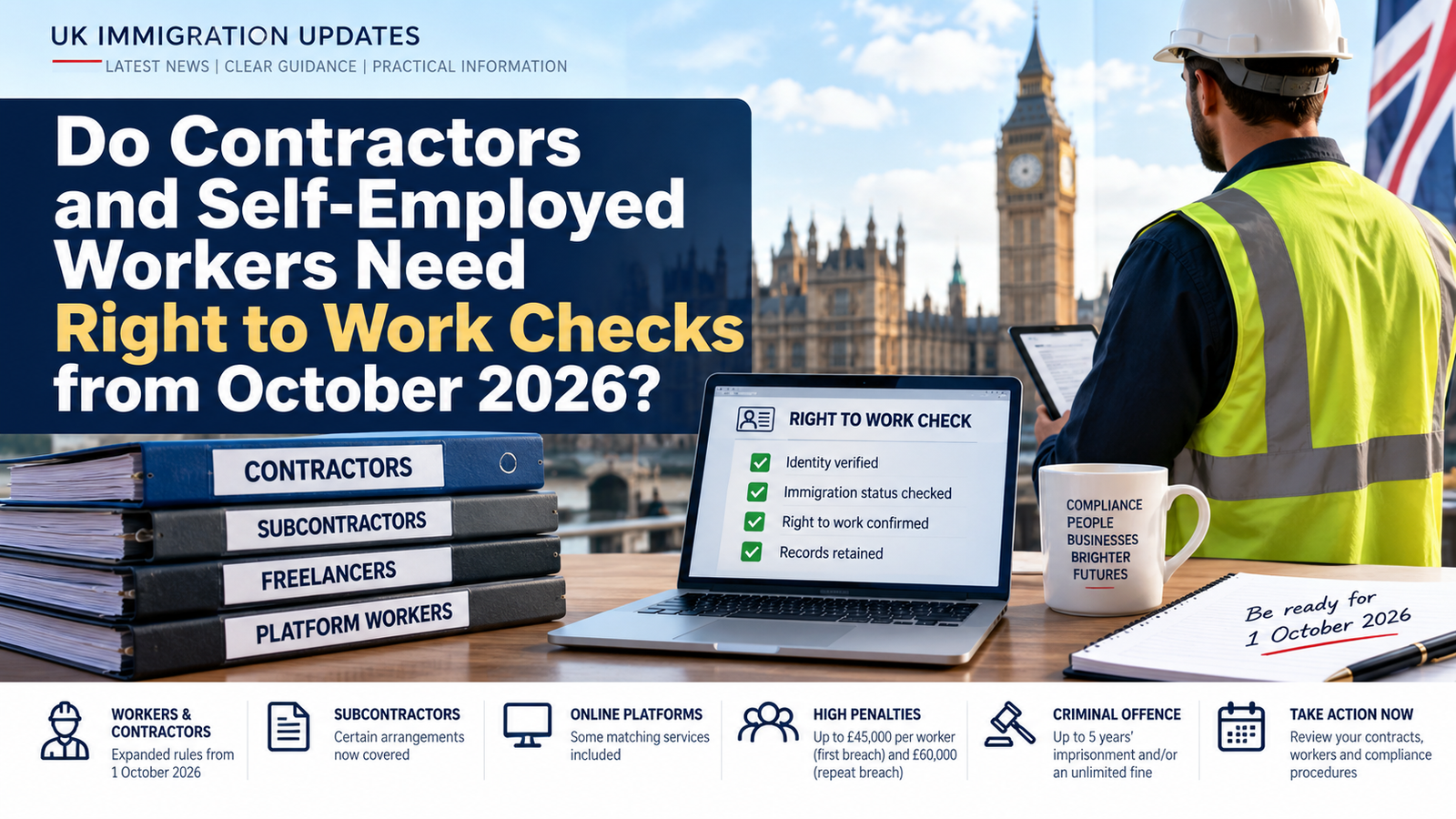
The UK’s Right to Work Scheme is due to undergo a significant expansion on 1 October 2026.
Businesses have traditionally associated Right to Work checks mainly with employees. From October, however, the illegal working regime will extend to certain other working arrangements, including people engaged under worker’s contracts, individual subcontractors and certain online matching services.
This raises an important question for businesses using contractors, freelancers and self-employed workers:
Will they now need Right to Work checks?
The answer is: not in every case.
The new rules do not mean that every genuinely self-employed person or independent contractor automatically requires a Right to Work check. However, the label “self-employed” or “contractor” will not determine the position by itself.
Businesses will need to consider how the working arrangement actually operates.
What changes on 1 October 2026?
Section 48 of the Border Security, Asylum and Immigration Act 2025 amends the Immigration, Asylum and Nationality Act 2006.
It inserts a new section 14A into the 2006 Act, expanding references to a person employing another individual for the purposes of sections 15 to 24 of the Act.
From 1 October 2026, this will include:
- engaging an individual under a worker’s contract;
- engaging an individual subcontractor; and
- operating an online matching service that provides details of an individual service provider to potential clients or customers.
Section 48 also inserts a new section 15A dealing with extended civil penalty liability in specified contractual arrangements.
The practical effect is that businesses should no longer assume that Right to Work responsibilities arise only where somebody has a conventional employment contract.
Does every self-employed person need a Right to Work check?
No.
The Home Office’s September 2026 draft guidance expressly addresses this issue.
It states that the guidance does not apply to individuals operating an independent business, either in their own name or through their own company, who contract directly with clients or customers to provide goods or services.
This includes typical business-to-business arrangements where the customer is purchasing a service rather than engaging an individual to perform work within the scope of the Right to Work Scheme.
The Home Office gives two particularly useful examples.
Example 1: A self-employed plumber
A self-employed plumber advertises their services directly to the public through different channels and obtains work from multiple customers.
A homeowner asks the plumber to repair a leaking tap.
According to the Home Office example, a Right to Work check is not required.
The plumber is operating an independent business and falls outside the scope of the Right to Work Scheme.
Example 2: A graphic designer operating through a company
A graphic designer works through their own personal service company.
A client company contracts with that company for the designer to work on a particular project, and the personal service company invoices the client.
Again, the Home Office says the client company is not required to conduct a Right to Work check.
The client is purchasing services from the personal service company rather than directly engaging the individual within the scope of the Right to Work Scheme.
Calling somebody “self-employed” is not enough
Businesses should not assume that simply describing somebody as “self-employed” or a “contractor” takes them outside the new rules.
The September Home Office draft makes clear that the substance of the arrangement and how it operates in practice should be considered.
The contractual label used by the parties will not, by itself, determine whether Right to Work responsibilities arise.
Relevant questions can include:
- Is the individual personally carrying out the work?
- Who engages or supplies the individual?
- Who is contractually responsible for providing the work?
- Is the organisation buying a defined service from an independent business or obtaining an individual to perform work?
- Is there a chain of contracts?
- Who determines or replaces the individuals performing the work?
- Is substitution permitted?
- What does the contract say and how does the arrangement actually operate?
The Home Office emphasises that no single factor is necessarily decisive.
What is a worker’s contract?
For the purposes of the expanded scheme, a worker’s contract is a contract, other than a contract of service or apprenticeship, under which:
- an individual undertakes personally to perform work or services for another person; and
- that person is neither a client nor customer of a profession or business undertaking carried on by the individual.
Contracts can be express or implied and oral or written.
This is one reason why businesses should look beyond labels such as “freelancer”, “contractor” or “self-employed”.
What is an individual subcontractor?
The legislation also brings certain individual subcontractors within the expanded Right to Work Scheme.
A simplified arrangement might look like this:
Business A → contracts Business B to provide work or services → Business B engages an individual to perform that work.
Depending upon the particular arrangement, Business B may be responsible for carrying out the individual’s Right to Work check.
Businesses operating through subcontracting arrangements should therefore consider who actually performs the work and how that individual is contractually engaged.
What about platform and gig workers?
The Home Office’s September draft gives another useful example.
An individual signs up to work through a delivery platform, logs into an app when they wish to work, accepts delivery requests and receives payment for each completed delivery.
For the purposes of the Right to Work Scheme, the Home Office treats the delivery platform as the individual’s employer.
The platform is therefore responsible for the Right to Work check and could be liable for a civil penalty if the individual is found to be working illegally.
This demonstrates why simply describing somebody as an “independent contractor” may not determine whether the Right to Work Scheme applies.
What about online matching services?
Certain online matching services are also brought within the expanded regime.
Broadly, this can involve an online service that maintains a register of service providers, matches them with potential clients or customers and charges a fee or commission for making those matches.
This does not mean every website, app or online marketplace automatically becomes responsible for Right to Work checks.
The particular business model and contractual arrangements must be examined.
What is extended liability?
Section 48 also introduces new section 15A into the Immigration, Asylum and Nationality Act 2006.
This creates extended liability for civil penalties in specified circumstances.
According to the September Home Office draft, extended liability can arise where:
- a person contracted to provide work or services to a third party contracts with another employer providing workers to perform that work;
- an online matching service matches a service provider with a client or customer and the service provider contracts with that client or customer; or
- an employer engages an individual under a contract allowing that individual to substitute another person to carry out the work.
This is not a general liability applying to every commercial supply chain.
The Home Office expressly says that it does not apply to every business purchasing work or services from another business, nor simply to a client, customer or end-user purchasing services for its own internal operations.
What about agency workers?
The Home Office guidance also distinguishes ordinary labour supply arrangements.
For example, where a manufacturer obtains temporary workers from an employment business, the employment business that directly employs the workers remains responsible for carrying out their prescribed Right to Work checks.
The manufacturer is not automatically subject to extended liability merely because it uses the temporary workers in its operations.
This illustrates why identifying the contractual relationships is important.
Substitution is particularly important
Contractors sometimes have agreements allowing them to send another person to perform the work in their place.
From 1 October, businesses operating with substitution clauses should pay particular attention to Right to Work compliance.
Where extended liability applies because an arrangement permits substitution, the prescribed processes require that:
- a prescribed Right to Work check is carried out on any substitute;
- responsibility for conducting the check is not delegated to the individual performing the work, including where that individual is described as being in business on their own account;
- no substitute begins work before their Right to Work has been verified;
- appropriate contractual provisions exist where illegal working is known or reasonably suspected; and
- appropriate identity verification systems are maintained.
This is important.
A business cannot necessarily protect itself simply by inserting a clause saying that the original contractor is responsible for checking whoever they send as a substitute.
Identity verification
There is a further issue: ensuring that the person actually performing the work is the person whose Right to Work has been checked.
The September Home Office draft says proportionate identity verification systems should be maintained.
Examples include:
- identity cards or workplace passes;
- facial recognition technology;
- biometric or attendance systems;
- checks against relevant qualifications, licences or training records; and
- periodic identity re-verification.
The Home Office currently recommends that identity re-verification takes place at least once in any 24-hour period or shift of work.
It also states that the frequency should be proportionate to the nature of the work and the risk of substitution or impersonation.
Importantly, this is about identity re-verification. It does not mean conducting an entirely new immigration Right to Work check every 24 hours.
As this recommendation appears in draft guidance due to take effect from 1 October, employers should check the final version when implementing their procedures.
Contracts alone may not be enough
Businesses potentially exposed to extended liability may need to comply with prescribed contractual requirements to establish a statutory excuse.
Depending upon the arrangement, this can include written contractual terms requiring:
- prescribed Right to Work checks;
- prior written consent for further subcontracting;
- equivalent Right to Work requirements in permitted subcontracting arrangements;
- compliance audits;
- appropriate enforcement action where illegal working is identified; and
- co-operation with Home Office investigations.
Businesses should not assume that simply inserting wording into a contract will necessarily be sufficient.
The way compliance processes operate in practice will also matter.
Do the changes apply to existing contractors?
There are important transitional provisions.
For newly covered employment under a worker’s contract, engagement as an individual subcontractor or relevant online matching arrangements, a civil penalty under the expanded scheme may only be imposed where the employment commences on or after 1 October 2026.
For extended liability, the prescribed contractual requirements apply where the relevant contractual arrangements are entered into on or after 1 October 2026.
Businesses should therefore consider both the nature of an arrangement and when it began.
Civil penalties can reach £60,000 per illegal worker
The financial consequences of illegal working can be substantial.
Under the current civil penalty framework, penalties can reach:
£45,000 per illegal worker for a first breach
and
£60,000 per illegal worker for a repeat breach.
The actual penalty is determined under the applicable civil penalty framework.
Conducting the prescribed Right to Work check correctly can establish a statutory excuse against liability for a civil penalty.
The criminal offence is also relevant to the expanded arrangements
It is important to distinguish civil penalties from criminal liability.
New section 14A expands the meaning of employment for the purposes of sections 15 to 24 of the Immigration, Asylum and Nationality Act 2006.
This means the expanded working arrangements are relevant not only to the civil penalty provisions but also to the criminal illegal-working offence in section 21.
An employer can commit an offence where they employ an individual who is disqualified from employment because of their immigration status and the employer knows or has reasonable cause to believe that this is the case.
The Home Office draft guidance states that the offence can carry a maximum sentence of five years’ imprisonment and/or an unlimited fine.
By contrast, the new extended liability provisions in section 15A concern civil penalty liability.
What about sponsor licence holders?
Sponsor licence holders have additional responsibilities.
Sponsors must check and retain evidence of the immigration status of any worker they sponsor.
The Home Office confirms that this applies irrespective of whether the particular arrangement otherwise falls within the scope of the general Right to Work Scheme.
Sponsor licence holders therefore need to consider Right to Work compliance alongside their wider sponsor duties, including record keeping, monitoring workers and reporting relevant changes.
Employers must avoid discrimination
Right to Work procedures must also be applied fairly and consistently.
Employers should not make assumptions about an individual’s Right to Work based upon matters such as their:
- race;
- nationality;
- ethnic or national origins;
- accent;
- surname; or
- length of residence in the UK.
Employers should ensure that their checking procedures are applied consistently rather than selectively checking individuals who appear or sound as though they may be migrants.
What should businesses do before 1 October 2026?
Businesses using contractors or flexible workers should consider reviewing:
- who actually performs work for the organisation;
- genuine independent busines
If you are looking for advice, then contact: UK immigration lawyers